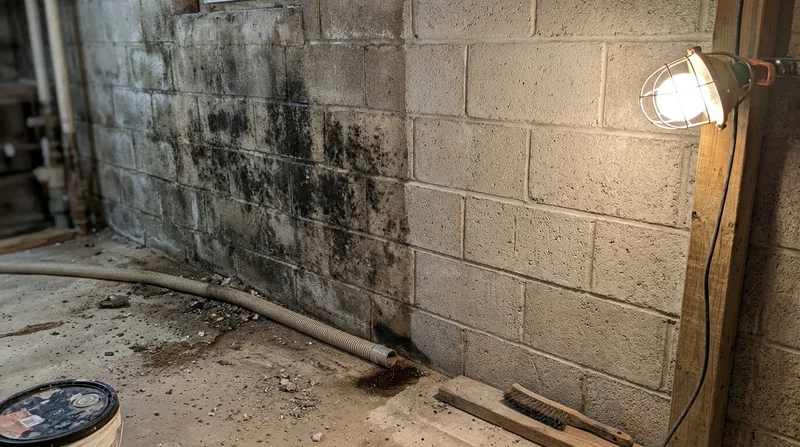




If you have a musty smell in your cellar and dark staining on the floor joists or lower wall panels, you are likely dealing with mold growth fed by chronic dampness. Basement Mold Remediation in New Bedford starts with finding the water source, not just spraying the visible growth. In the South End and Acushnet Heights, many 1880s to 1920s triple-deckers and two-families sit on granite or fieldstone cellars that stay damp because the water table is close and the old footing drains are silted shut. Out on the west side and in Fort Rodman, 1920s to 1950s Capes and ranches have poured or block walls with clay footing drains that no longer carry water away. We handle the moisture fix and the cleanup together, so the growth does not return after the first humid week. Call (774) 425-8595 to schedule a free basement inspection and a musty smell diagnostic.
Why Mold Grows in New Bedford Cellars and What Feeds It
Mold needs three things: moisture, organic material, and still air. New Bedford basements supply all three. The ground here is sandy glacial outwash near the harbor and dense clay pockets inland, and low lots along the Acushnet River hold groundwater close to the surface. Nor'easters, heavy autumn rain, and spring snowmelt push water against old cellar walls, and tidal surges reach the lowest streets. That water wicks through granite mortar joints, brick, and porous block, then evaporates into a closed basement with no ventilation. The result is high humidity, condensation on cool walls and pipes, and mold growth on joists, subfloor, cardboard, and stored goods.
- Hydrostatic pressure forces water through hairline cracks and mortar joints in old fieldstone and brick walls.
- Failed footing drains and clogged drain tile leave water standing against the foundation instead of carrying it away.
- Missing or torn vapor barriers let ground moisture evaporate straight into the basement air.
- Downspouts that dump next to the foundation and flat grading send roof water back to the wall.
- Cold water pipes and uninsulated rim joists sweat in summer and feed growth on adjacent wood.
Each of these is a moisture path we can trace and correct, which is why we treat the mold and the water source as one job.
Key info: A South End triple-decker with a granite cellar wall and a musty odor on the first floor usually has water entering at the cove joint where the wall meets the floor. Sealing the visible mold without addressing that joint guarantees the growth returns by the next humid spell.
For official guidance on moisture and mold in buildings, the U.S. Environmental Protection Agency publishes a homeowner resource at epa.gov/mold.
How We Run Basement Mold Remediation in New Bedford
We work in a fixed sequence: find the water, stop the water, dry the structure, then remove the growth. Skipping the moisture step is the most common reason remediation fails. We inspect the full perimeter, check the sump basin and discharge line, test the grading and downspouts, and look for efflorescence and staining patterns that show where water travels. Then we set up containment and negative air so spores do not spread through the house during removal.
- We perform a free basement inspection and musty smell diagnostic to map moisture sources and affected materials.
- We set up plastic containment and negative air pressure to isolate the work area from the rest of the home.
- We remove porous materials that cannot be cleaned, such as soggy drywall, insulation, and ruined cardboard.
- We HEPA-vacuum and treat framing and masonry surfaces with an approved antimicrobial cleaner.
- We correct the water path with crack injection, interior perimeter drain, sump pump work, or vapor barrier as the inspection dictates.
- We dry the space with commercial dehumidifiers and verify moisture readings before we close out.
The job is not done until the basement stays dry through a rain cycle, which is the only real proof the moisture source is controlled.
Key info: A 1950s ranch in Smith Mills had mold on the bottom two feet of a block wall and a sump pit that ran dry in storms. The real problem was a cracked footing drain that let water sit against the wall. We installed an interior drain tile system, tied it to a new sump basin, and the wall stayed dry through the next spring melt.
Remediation and Moisture-Control Methods We Use
Not every basement needs the same fix. A single hairline crack that weeps after heavy rain is a different job than a fieldstone wall with water pushing through mortar under hydrostatic pressure. We match the method to the diagnosis, and we tell you plainly when simple crack sealing is enough and when an interior drain tile system is the better answer than exterior excavation.
| Approach | Description | Best for |
|---|---|---|
| Containment and HEPA removal | Isolate the work zone, remove ruined porous materials, HEPA-vacuum and treat remaining surfaces. | Visible growth on joists, drywall, or stored goods after a wet event. |
| Crack injection (epoxy or polyurethane) | Seal weeping cracks in poured concrete walls from the inside with injection ports. | A defined crack that leaks after rain, with no broad wall seepage. |
| Interior perimeter drain and sump | Cut a channel at the wall-floor joint, install drain tile into a sump basin, discharge outside. | Hydrostatic pressure, water at the cove joint, wet floor across the slab. |
| Vapor barrier and dehumidification | Cover exposed ground with a sealed vapor barrier and run controlled dehumidification. | High humidity, condensation on cool surfaces, no standing water. |
| Grading and downspout correction | Regrade soil away from the wall and extend downspouts to move roof water off the foundation. | Water pooling at the foundation after storms, damp walls near downspouts. |
We choose the least invasive method that actually solves the moisture path, and we explain the reasoning before any work begins.
Basement Mold Remediation Cost in New Bedford: What to Expect
Small jobs start from $1,500. That figure covers a contained work area, removal of affected porous materials, HEPA vacuuming and surface treatment, and a moisture check. Most New Bedford jobs land above that starting point because the mold is a symptom of a water problem that also needs correction. A weeping crack that needs injection adds to the scope, and a full interior perimeter drain with a sump basin is a larger project. The size of the affected area, the number of rooms involved, whether the basement is finished, and the drainage work required all move the number.
We give you a written scope that separates the cleanup from the moisture fix, so you can see what each part costs. Getting two or three estimates is smart, and so is asking each contractor whether the price includes the drainage correction or only the surface treatment. A quote that only sprays the mold is not a remediation plan. Our full pricing overview is at new-bedford-waterproofing.com/pricing.
Hiring a Basement Mold Remediation Contractor Near Me in New Bedford
You want a contractor who diagnoses moisture, not one who only treats surfaces. Ask for proof of licensing and insurance, and ask whether the crew will correct the water path or hand you a separate bill for it later. In New Bedford's older neighborhoods, many cellars have granite walls and no existing drain tile, so experience with that building stock matters. Permits are commonly required for structural foundation repair and for work that alters drainage or the sanitary connection of a sump discharge, and thresholds vary by jurisdiction, so confirm with the New Bedford building department before work starts.
- Verify the contractor is licensed and insured, and request a certificate of insurance.
- Get two or three written estimates with the same scope so you can compare fairly.
- Ask for references from jobs in New Bedford and nearby towns with similar basement construction.
- Confirm who pulls any required permit and whether the building department must inspect the work.
- Ask what the warranty covers and whether it is transferable.
If a contractor cannot explain how water is getting in, keep looking. You can reach us at new-bedford-waterproofing.com/contact to schedule a free inspection.
Basement Mold Remediation in New Bedford: Pricing Guide
| Service | Price | Details |
|---|---|---|
| Contained cleanup and surface treatment | Starting at $1,500 | Includes containment, HEPA vacuuming, antimicrobial treatment, and a moisture check on a limited area. |
| Cleanup plus crack injection | Starting at $2,200 | Adds epoxy or polyurethane injection of weeping cracks, priced by crack length and wall access. |
| Cleanup plus interior drain tile and sump | Starting at $5,500 | Adds interior perimeter drain, sump basin, and discharge line, priced by linear feet and pump choice. |
| Finished basement remediation | On estimate | Finished walls and ceilings require selective demolition and drying, so we inspect before quoting. |
| Travel | Included | In New Bedford and surrounding areas, no separate call-out or mileage fee. |
| Estimate | Free | Response within 24h at (774) 425-8595, no obligation to book. |
Indicative pricing, the exact cost depends on square footage, finish, and site access. Free personalized estimate within 24h at (774) 425-8595.


